

Theater Performance Sized to the Actual Room
Home theater installation in Tarzana for dedicated media rooms and finished spaces where display size, speaker placement and acoustics must be planned around existing sightlines and seating
What changes after a properly installed home theater is complete is specific: the display fills the sightline from every seat without requiring viewers to turn their heads, dialogue arrives from in front of the screen rather than from a soundbar below it, and low-frequency content from the subwoofer is felt at the seating position rather than concentrated in one corner of the room. Foremost Automation installs home theaters in Tarzana, sizing each system to the room's dimensions, seating layout and budget rather than to a catalog configuration. The same company that installs the theater handles the home's automation, so the theater system and the rest of the house operate through one control platform.
Installation starts with room measurement and planning: display size is calculated from seating distance and viewing angle, speaker positions are mapped to the room's dimensions and construction, and subwoofer placement is chosen to avoid the standing-wave buildup that makes bass response uneven across different seats. In large single-family homes with dedicated media rooms, these decisions are shaped by how the room is finished—ceiling height, wall material, floor surface and whether acoustic treatment is already in place all affect the system spec before a single component is selected.
Request a room measurement and system plan from Foremost Automation before committing to any display or speaker specification.
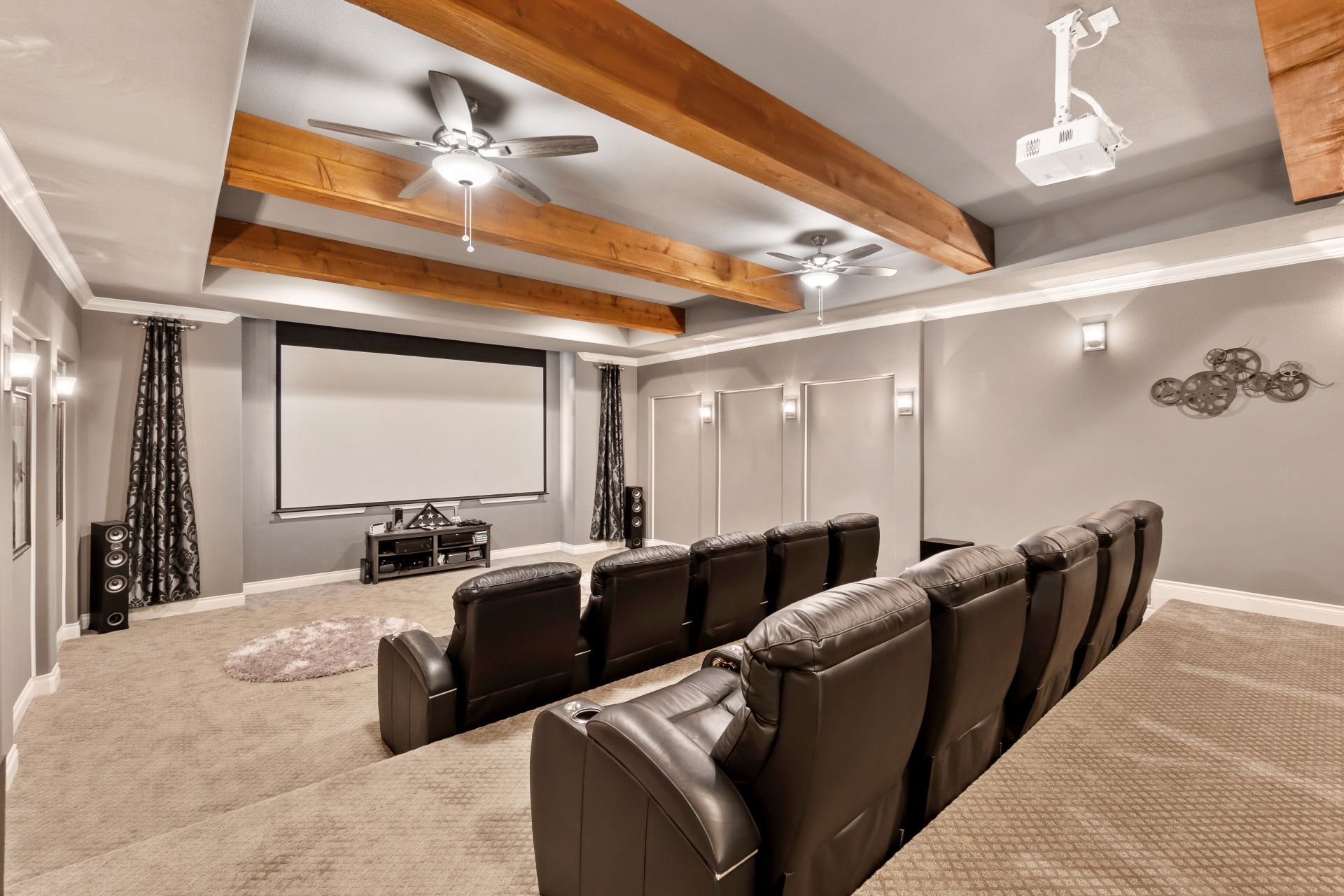
Why Speaker Placement and Subwoofer Position Decide the Result
Speaker placement is not a preference decision—it is a geometry decision. Front left, center and right speakers must align horizontally with the display so that sound tracks with on-screen action, and surround speakers must be positioned at the correct angle and height relative to the listening position to produce the spatial separation that makes immersive audio formats work as intended. When placement is determined after furniture is arranged rather than before, the geometry is often wrong in ways that cannot be corrected through calibration alone.
Foremost Automation calibrates the system after installation using room correction tools that measure the acoustic output at the listening position and adjust speaker levels, timing delays and equalization to compensate for the room's specific behavior. After calibration, the audible difference at the seating position is that dialogue, effects and music are balanced without one element overriding the others, and the soundstage is anchored to the screen rather than pulled toward whichever speaker or surface dominates the room's acoustics. Streaming, disc playback and other sources are integrated and switchable from one control point.
Open-plan rooms with large windows and hard surfaces present additional complexity that dedicated media rooms do not: reflections from glass and tile affect dialogue clarity, and the absence of a defined rear wall changes how surround speakers need to be positioned and angled. A home theater in this type of space may require different speaker models or acoustic panels at specific reflection points to achieve the same result that a properly enclosed room produces without them—that assessment is made during the planning visit rather than after installation.
Questions Before Starting Your Project
These questions address the planning, installation and calibration decisions that determine how a home theater performs in the finished room.
How is display size calculated for a specific room and seating arrangement?How is display size calculated for a specific room and seating arrangement?
Display width is determined by the distance from the screen to the primary seating row and the desired viewing angle—a display that appears immersive from twelve feet requires a significantly larger panel than one that appears immersive from eight feet, and this calculation is done before any display is specified.
Why does subwoofer position affect bass performance across different seats?
Low-frequency sound creates standing waves in enclosed rooms, causing some seating positions to receive excessive bass and others to receive almost none—subwoofer placement is chosen to minimize this variation, and in some rooms more than one subwoofer is required to achieve consistent response across all seats.
What happens during the calibration step after all components are installed?
A calibration microphone is placed at the primary listening position and the receiver or processor measures the output of each speaker individually, then applies level adjustments, delay settings and equalization to correct for differences in distance, room reflections and speaker frequency response.
How does the room's construction affect which speaker types are specified?
Rooms in large Tarzana homes with high ceilings and hard floors require speakers and placement strategies that account for extended reverberation time—speakers with controlled directivity or in-wall installation combined with acoustic panels are often more effective in those rooms than freestanding speakers aimed at an open space.
What is the difference between a system that is installed and one that is integrated with the rest of the home?
An installed theater operates through its own remote and inputs; an integrated theater is connected to the home's automation platform so that a single command—or a scheduled scene—can power the room, set the lighting, lower shades and switch to the selected source without separate inputs at the receiver, display or streaming device.
Foremost Automation also installs home theaters in Burbank, Glendale, Pasadena, Santa Monica and Thousand Oaks. To begin with a room measurement and a system plan built around your space and seating layout, call Foremost Automation at (818) 660-5580.